
Bloomfield Township City Directory Collections and Years
The historical shelf for Bloomfield Township is distributed across bibliographies, digitized volumes, library holdings, and county-history catalogs. The early titles use changing geographic language, so a directory whose title includes Birmingham, Bloomfield Hills, Beverly Hills, or Oakland County may still be the correct item for a dated Bloomfield Township search. The collection table records verified runs or holdings rather than assuming a continuous annual series.
| Collection | Verified years or item | Where held | Access |
|---|---|---|---|
| Newberry directory bibliography | Birmingham, Eco City & Oakland County 1925; Birmingham/Bloomfield Twp 1926; mixed localities 1927 and 1930 | Newberry Library bibliography | Online bibliography PDF |
| Birmingham volumes | Full-view 1930 item; 1940 Beverly Hills edition metadata and OCR | Google Books | Online item and searchable OCR |
| Polk and community directories | Polk Birmingham 1937, 1984, 1985; Birmingham-Bloomfield Hills Community Directory 1986 | Oakland County Historical Society / Oakland History Center catalog | Catalog and repository inquiry |
| Telephone directories | Pontiac-Bloomfield Hills 1935, 1937, 1939, 1940, 1942, 1943 | Oakland County Historical Society / Oakland History Center | Repository holding |
| Local newspapers and historical material | Birmingham-Bloomfield Eccentric run identified as 1882–1964 | BTPL digital archive | Archive and library databases |
Gaps matter. The catalog establishes that a repository holds particular volumes; it does not promise that every volume is digitized, that every page is indexed, or that every historical person appears in a given edition.
Bloomfield Township City Archive: The 1925–1930 Bridge
Newberry's bibliography offers a compact early bridge because it names the localities in the title itself. It lists Birmingham, Eco City and Oakland County for 1925; Birmingham and Bloomfield Township for 1926; Birmingham, Bloomfield Hills and Bloomfield Township for 1927; and a mixed Birmingham, Bloomfield Hills, Beverly Hills and Bloomfield title for 1930. The changing title is evidence of the publisher's coverage language, not a reason to merge distinct legal places.
Search the Newberry city-directory bibliography first when identifying an edition, then record the printed title and year in the research note. This makes it possible to distinguish a real collection gap from a search conducted under the wrong locality label.
Bloomfield Township City Phone Holdings
Later Bloomfield Township directory work can use the Oakland County Historical Society and Oakland History Center shelf list. Its Polk Birmingham volumes for 1937, 1984, and 1985, the 1986 community directory, and the 1935–1943 telephone sequence offer distinct time slices rather than one continuous run. A telephone directory can bridge a missing city-directory year, but a telephone listing has its own publisher rules and should be cited as such.
The Oakland History Center catalog is the route to confirm the specific volume or request a repository visit. Ask for the exact edition and whether it is on an open shelf, in a reference area, on microfilm, or available as a staff-mediated archive item.
Bloomfield Township City History Research at BTPL
Bloomfield Township Public Library's History Collection is the practical local hub for historical volumes, yearbooks, photographs, newsletters, printed ephemera, and local-organization material. It is at 1099 Lone Pine Road, Bloomfield Township, MI 48302, and lists 248-642-5800. The published schedule is Monday through Thursday 9:30–9:00, Friday 9:30–6:30, Saturday 9:30–5:30, and Sunday noon–5:30.
Reference items do not circulate, and archive material is used in the library under staff supervision. Before arriving, name a year and format: a 1926 Birmingham/Bloomfield Township directory, a telephone volume, an Eccentric issue, or a map. The BTPL History Collection page also points researchers to its digital catalog, archive, and partner repositories when a volume is not immediately available.
BTPL lists Ancestry Library Edition and Fold3 as in-library resources, FamilySearch with free registration, and MyHeritage for remote access. Those resources can help locate a lead, but the directory page, image, or repository record is what should be cited for a historical entry.
The library's digital catalog at btpl.recollectcms.com and the archive at archive.btpl.org are different entry points. The archive includes the Birmingham-Bloomfield Eccentric route and other local material, but the public history page does not promise a complete title-by-year index or a separate complete obituary index. Search the catalog for the printed locality, publisher, and year, then ask staff whether the item is a scan, reference item, microfilm, supervised archive object, or a partner-database lead. That question often resolves an apparent online gap without overstating what has been digitized.
BTPL's referral list is also part of the access path: Archives of Michigan, Bentley Historical Library, Birmingham Museum, Burton Historical Collection, Michiganology, Oakland County Clerk/Register of Deeds, Oakland County Historical Society, Reuther Library, and local genealogy societies. A request that names the exact year and format gives each repository a usable starting point and makes its response easier to document.
How a Bloomfield Township City Entry Reads
A directory entry is an inventory of what a publisher printed for one edition. The digitized Birmingham material and Michigan Library guide show the familiar sequence of surname and given name, household notation, a printed activity or business line, address, and sometimes ownership or renter marks, widow notation, or page references. The exact symbols and abbreviations must be read from that volume's own key.
| Printed element | How to read it |
|---|---|
| Name and household notation | Record the spelling and parentheses exactly; a spouse or household name is only what the edition printed. |
| Address line | Preserve number, road suffix, directional, township abbreviation, and postal wording before normalizing it for a separate search. |
| Activity or business line | Keep the printed abbreviation or business wording; do not expand a code beyond the edition's key. |
| Owner or renter mark | Use only when that publisher printed a mark, and treat it as an edition-date classification. |
| Widow or status notation | Keep it as a historical clue, not a substitute for a vital record. |
- Criss-cross section
- The street-order portion of a directory, useful for moving from an address to the printed household head.
- Householder index
- An alphabetical route to the person or household line before checking the address sequence.
- Abbreviation key
- The volume's explanation of its printed shorthand; photograph or note it before interpreting the entries.
No fully legible, stable single Bloomfield household line was captured in the reviewed online source. That gap is a reason to request a page image and its key, not a reason to manufacture an example.
Reading a Bloomfield Township City Address Backward
Polk and Bresser methodology explains why a criss-cross volume is valuable to address history. These directories may reverse street or telephone information to household heads and can carry date-sensitive marks such as year first listed, new arrival, relocation, or an owner or renter notation. Read the address form as printed, then inspect the same surname in the alphabetical section and compare adjacent editions.
The Library of Michigan city-directory guide explains the directory method, while BTPL and Oakland County collections establish the local holdings. A reverse entry identifies a printed association for the edition; it does not settle a current residence question.
The Bloomfield Township City Eccentric Archive
The Birmingham-Bloomfield Eccentric is a companion source rather than a printed directory, yet it can supply a date, street reference, community notice, legal notice, or name variant to test against an edition. The historical society research material identifies a digitized Eccentric run from 1882 through 1964, and BTPL points researchers to the archive and its historical newspaper access.
The digitized Birmingham volume provides a visible 1930 directory route with searchable OCR and edition context.
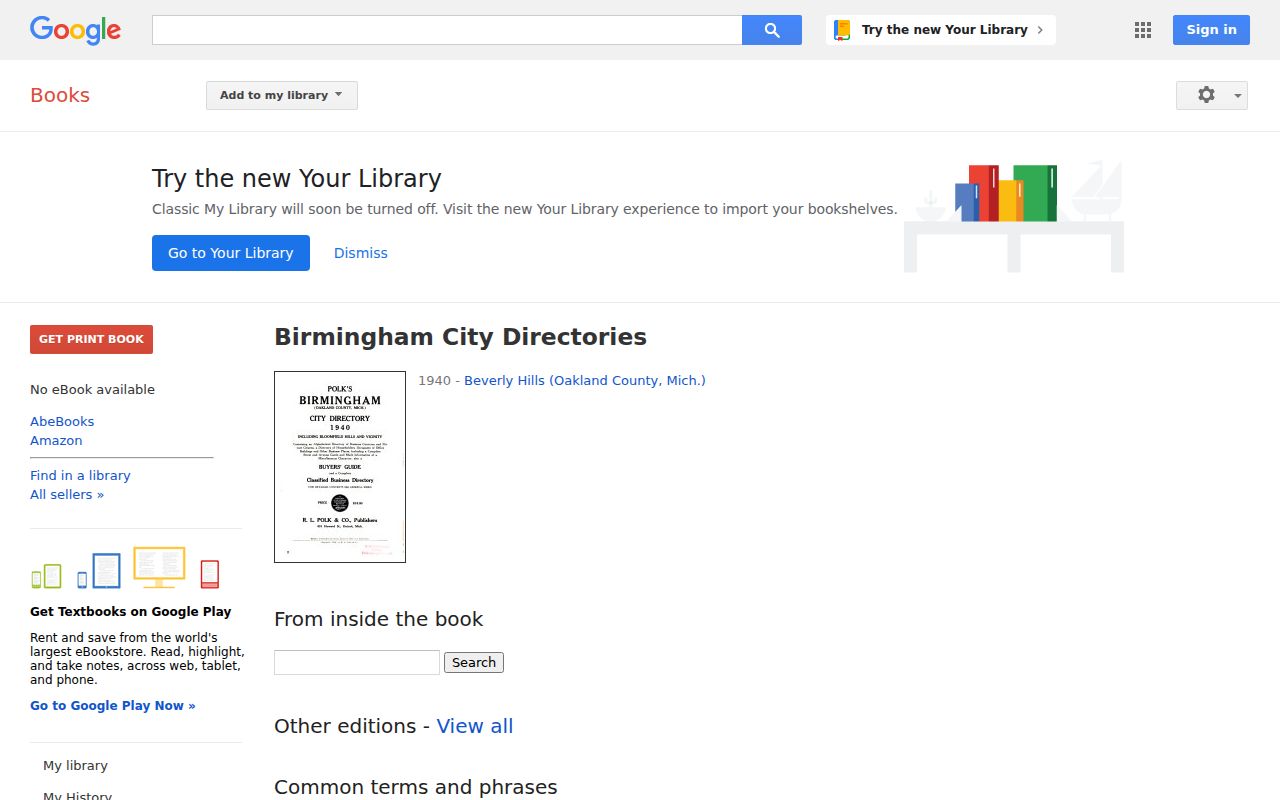
OCR is only a finding aid, particularly for B'fieldTwp text, initials, and road abbreviations, so verify each result against the scan and nearby entries.
Tracing a Bloomfield Township City Directory Household
Follow one address or name through a sequence of editions, while keeping a dated evidence trail. The method works best with a mix of directory, census, parcel, deed, tax-card, and newspaper evidence because each source is created for a different purpose and can expose a different timing or spelling.
- Find the first identified edition and transcribe its title, page or image, spelling, address, and every relevant printed mark.
- Check earlier and later editions for moves, a changed household line, a new spelling, or a disappearance.
- Use the criss-cross portion when available to compare the address with nearby printed households for that same edition.
- Pair the year with the nearest public federal census, a dated deed or assessment record, and the Eccentric archive where a contemporary notice may exist.
- Close the note with what the evidence proves and what remains uncertain, including a missing edition or unreadable OCR line.
Disappearance from a city directory can mean a move, a changed publisher rule, an unlisted number, a death, or a gap in the run. A vital-record or newspaper route may help, but no single explanation should be assumed from a missing line.
Bloomfield Township City Spelling and Access Limits
Historical searches must respect the difference between a postal label and a legal unit. Birmingham, Bloomfield Hills, Bloomfield Twp, and road abbreviations may be the printed language of one source. Preserve it, then compare it to the record system that owns the next question. The 72-year public-release rule also makes federal census material a different time-specific source, not a replacement for a directory.
Use all the documented access paths when the web search stops: BTPL's catalog and supervised History Collection, the BTPL archive, Google Books, Newberry's bibliography, the Oakland History Center catalog, Library of Michigan guidance, Archives of Michigan, Bentley, Burton, Birmingham Museum, and repository phone or appointment requests. For a modern name-verification question after a historical find, use the Bloomfield Township resident lookup guide instead of stretching an old directory line past its date.